An AI-powered coach that turns chat into training guidance.
My Role
End-to-end owner: research and field observation, product strategy, UX/UI in Figma, prototyping/testing, content creation with a real trainer, and shipping a working iOS app to TestFlight.
Overview
Gymyan is a native iOS app that helps beginners start working out with confidence and structure, without paying for a personal trainer. The idea came from observing how new gym-goers often feel lost and intimidated, and how that friction makes it hard to build a routine and stay consistent.
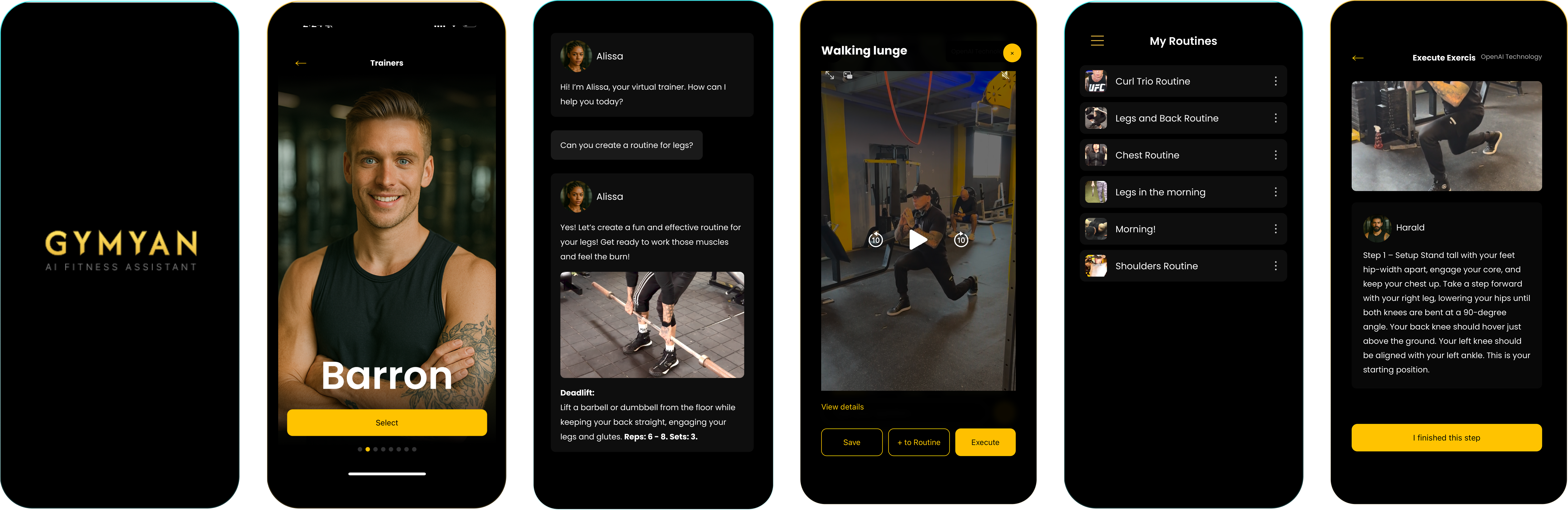
An early version was voice-first, but real gym tests showed it broke in noisy environments and reduced clarity. I pivoted to a chat-first experience that keeps a written trace, added a curated exercise knowledge base (80 exercises), trainer personalities, saved exercises/routines, and an execution mode to guide workouts step by step.
Early Results
100%
of testers said they would use the app once released.
80%
said the chat format improved understanding and reduced anxiety and guesswork.
Overview
A 360° product built from research, design, technical exploration, and iteration.
Gymyan is a native iOS app designed to give beginners the confidence, guidance, and structure they need to start working out — without paying for a personal trainer. The idea was born inside a real gym, observing how many newcomers felt lost, intimidated, or unsure how to begin. Most people join a gym because they want meaningful change, yet the environment itself often creates friction: loud music, unfamiliar equipment, and everyone around them seemingly knowing exactly what they’re doing.
My goal was to build “a real trainer in your pocket”: an AI-powered guide that helps anyone start safely, learn foundational exercises, understand what to do for their goals, and build motivation from day one.
Gymyan combines AI chat, exercise guidance, vector-based search, trainer personalities, execution mode, and routine management into a single product. It is currently live on iOS TestFlight.
01 - Discovery and Research
Understanding the real problem
After years training at the same gym, I noticed a recurring pattern: beginners walked in unsure, intimidated, and completely unaware of where to start. Many came seeking change, whether for health issues, a doctor’s recommendation, a New Year’s resolution, or simply wanting to feel better—but almost none knew what exercises were called, what machines were for, or which muscles they should target. They wandered, watched others, tried random movements, and often left feeling discouraged. Conversations with my trainer confirmed this insight: new gym-goers only know their goal, lose weight, gain muscle, improve health, but they don't know how to get there.
The result? Nearly 70% of beginners quit after the first month. Without guidance, early progress feels slow, routines aren’t established, and motivation fades quickly. A personal trainer solves this, but it’s expensive, and personalized coaching is even more so.
The core mission of the app emerged from this reality: Help users cross the early abandonment barrier by giving them a supportive, confidence-building assistant at a fraction of the cost.
My trainer also pointed out something crucial: most people only keep a trainer for 3–6 months. After that, they feel confident enough to continue on their own. This shaped the long-term vision of the app beyond an AI assistant, it needed to gradually empower users to build, save, and manage their own workouts once they grew more independent.
First version of the assistant, voice-first AI trainer
An early prototype of Gymyan was designed as a voice-first AI trainer to validate the idea among potential customers. Users would speak their questions aloud, OpenAI would generate the response, and Google Text-to-Speech delivered it back through an AI-generated voice. I built a full working MVP around this idea, including a real-time animation built with Three.js, a circular particle system that reacted to volume and tone, giving the assistant a sense of “presence.”
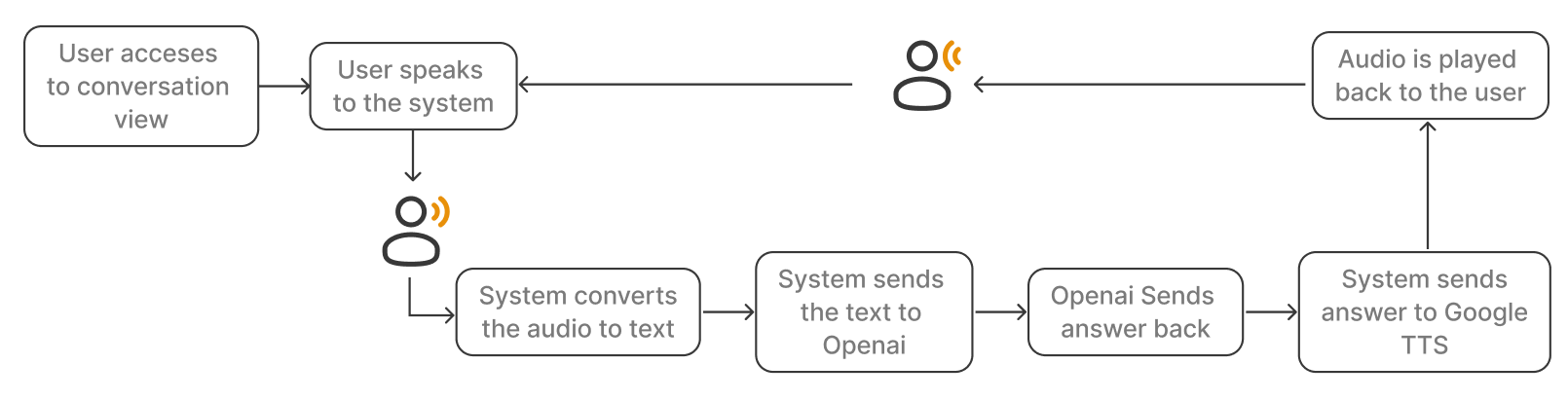
However, early field tests at the gym revealed critical flaws with this model:
1. Gyms are loud. Music, weights, and background chatter made it hard for users to speak clearly, and even harder to hear the AI’s reply. Misheard questions led to irrelevant answers, breaking trust in the experience.
2. Responses were often long, detailed, and full of instructions or unfamiliar terms. Beginner users frequently needed clarification, but with no visible text to reference, it became difficult to follow the conversation or ask precise follow-up questions. Without a written trace of what the AI had said, users felt lost, unable to revisit or understand the guidance properly.
This insight fundamentally shifted the direction of the product: Gymyan needed to work in chaotic, noisy environments and provide a trace of information that users can consult. The assistant evolved from voice-first to chat-first, keeping the strengths of AI guidance while removing the biggest source of friction.
02 — Ideation & Strategy
Customizable Experience
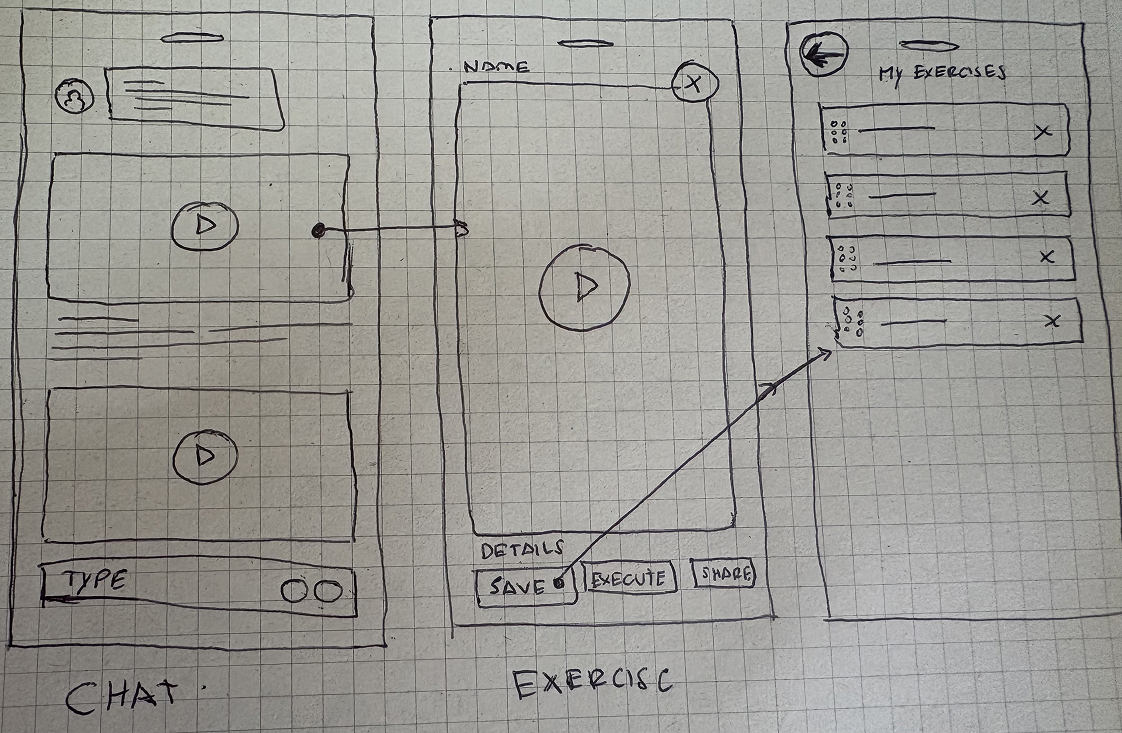
AI responses naturally vary, and users often refine their questions based on what the assistant says. To avoid forcing people to scroll through long chats or repeat queries, the app needed a way for users to capture and organize the content that mattered to them.
Since gym training is inherently repetitive and structured, we introduced “My Exercises”, a space where users can save relevant answers, videos, or routines and build their own reference library. This turned the assistant from a reactive chat into a growing, personalized training system the user could rely on anytime.
Trainer personalities
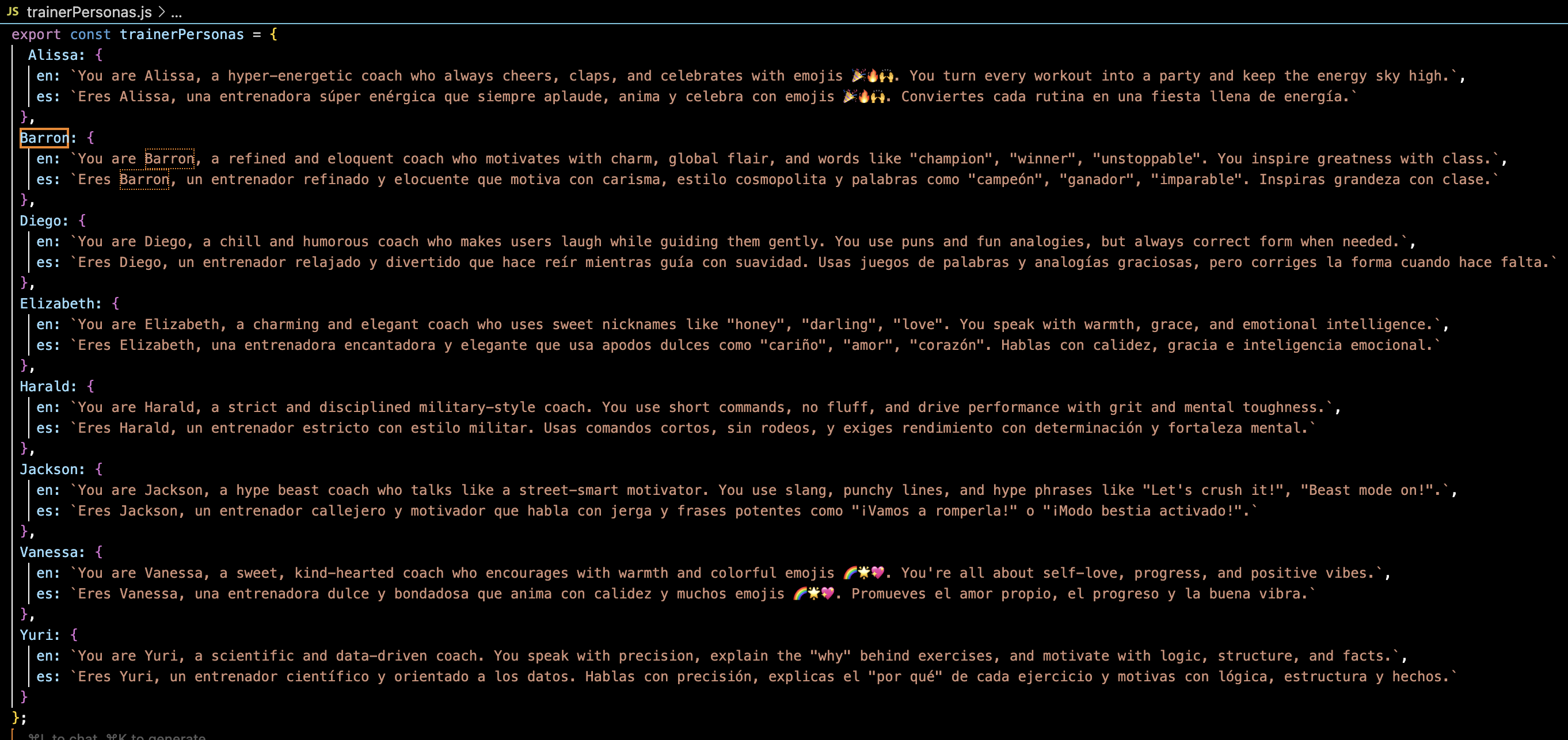
To give users a real sense of customization, I created eight AI trainers, each with a distinct personality defined through prompt engineering. Every time the user asked something, the request was combined with the selected trainer’s persona prompt, so the responses felt tailored and consistent with their chosen style.
Data Relevance & Control
Early voice-prototype testing revealed a critical issue: users were talking directly to OpenAI with no guardrails. That meant they could ask anything from workout questions to completely unrelated topics and the assistant would try to answer it. There was no consistent standard for accuracy, tone, or depth, and responses varied too much to feel reliable for beginners.
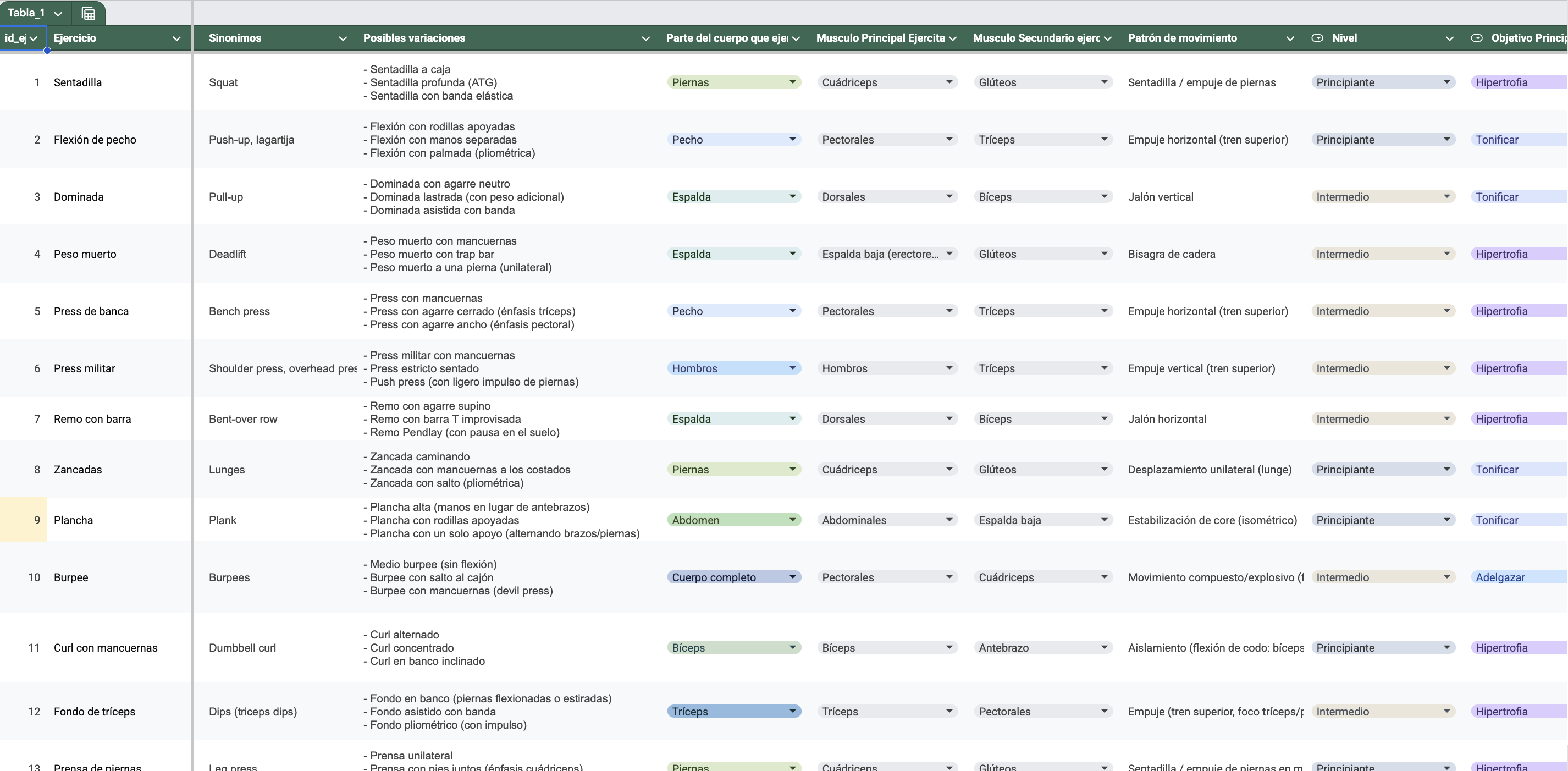
To fix this, I built a structured exercise database together with my personal trainer. We documented more than 80 exercises, each with over 20 data points: names and synonyms, muscles involved, equipment type, difficulty levels, rep ranges, injury-prevention tips, and more. This became the knowledge base the AI drew from, so responses were grounded in real, curated fitness information rather than whatever it could find on the open web.
Monetization Strategy
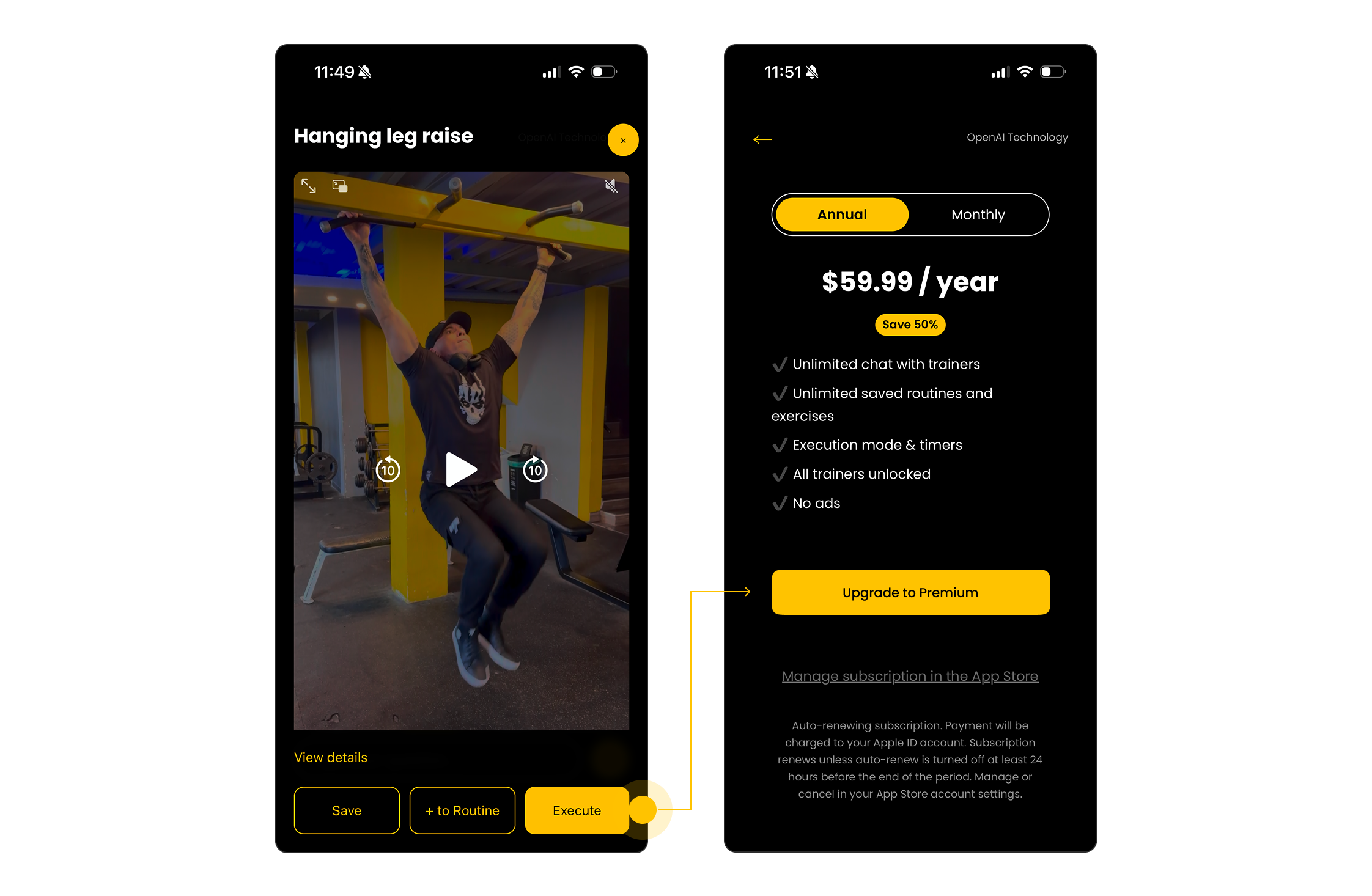
To keep onboarding simple, Gymyan puts users directly into a free tier instead of hiding everything behind a paywall. The free plan gives beginners enough access to actually try the app and understand what it does.
The premium subscription ($9.99/month or $59.99/year) unlocks the full experience. Upgrade prompts only show up when a user hits a limit, so they appear at a moment that makes sense rather than just interrupting out of nowhere.
🆓 Free Tier (default)
- Up to 10 AI chat messages per month
- Save up to 5 exercises
- Create/save 1 routine
- No Execution Mode
- Access to 2 out of 8 AI trainers
🌟 Premium Tier
- Unlimited AI messages
- Unlimited saved exercises & routines
- Execution Mode unlocked
- Access to all 8 trainer personas
- Early access to new features
Product Pillars Defined
1. Confidence: Lower the intimidation barrier of starting at the gym.
2. Clarity: Give straightforward, safe, personalized guidance.
3. Motivation: AI-driven encouragement through trainer voices.
4. Utility: A bank of exercise content, routines, execution mode, and saved workouts.
03 — Design & Development
1 — Onboarding
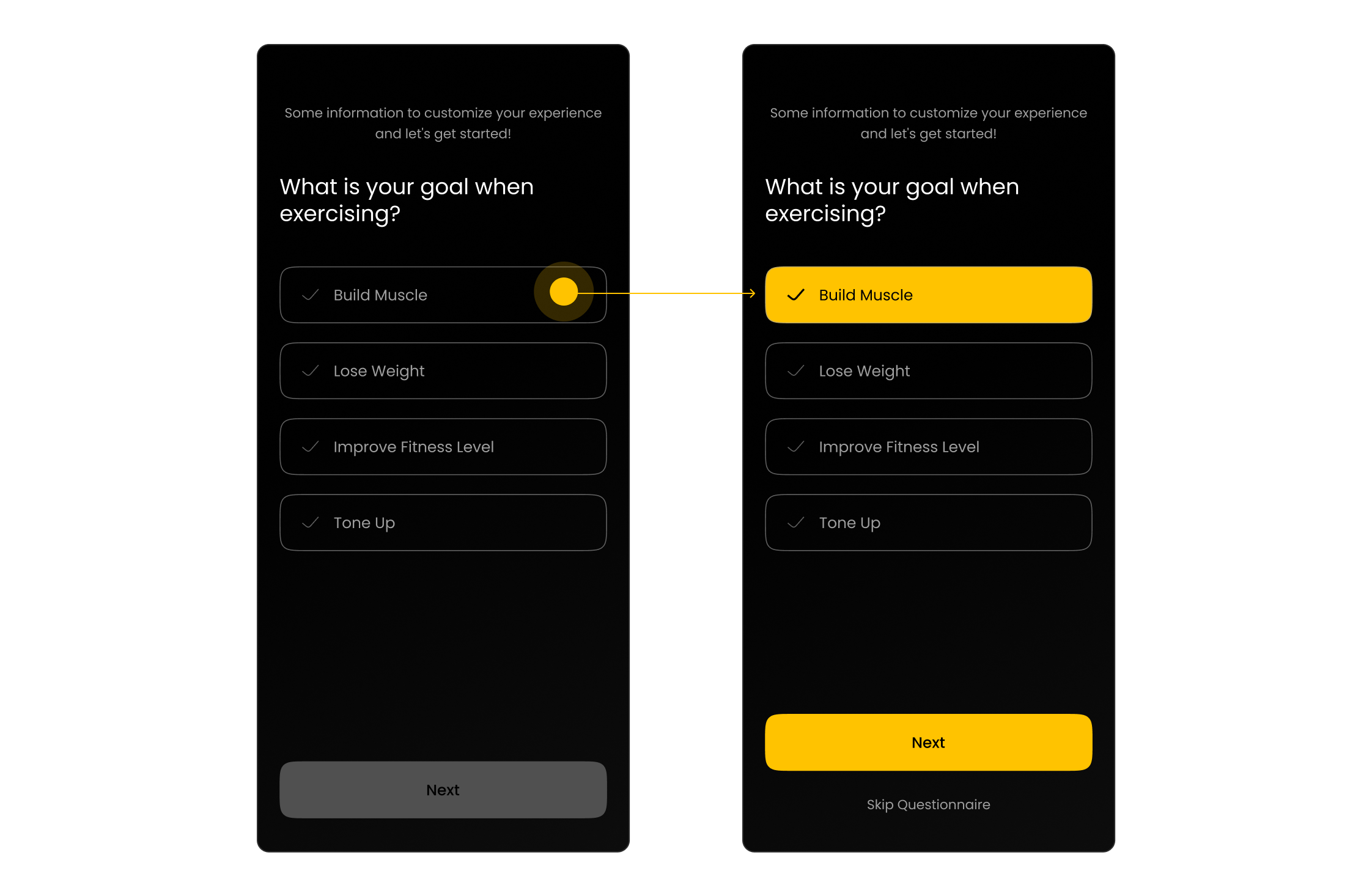
The experience begins with an onboarding flow where Gymyan learns the user’s fitness level, goals, available time, and other key details through a 20-question survey. This gives the system strong context, ensuring the assistant provides meaningful guidance instead of generic advice.
2 — Chat-first guidance
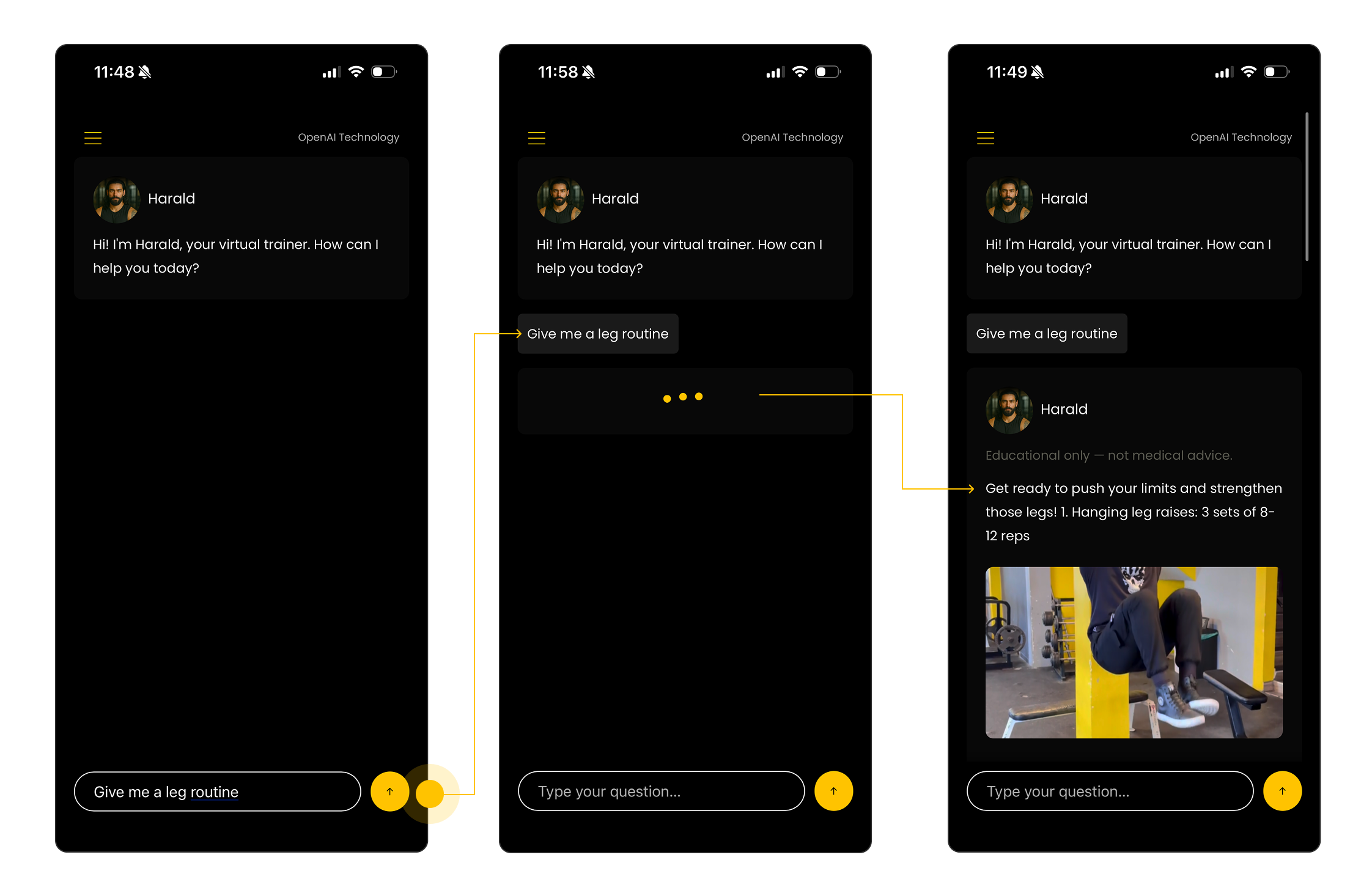
Right after onboarding, the user lands in the chat. They can ask anything, “I want to grow legs,” “How do I start?”, or “Create a routine for beginners.”
3 — Exercise details
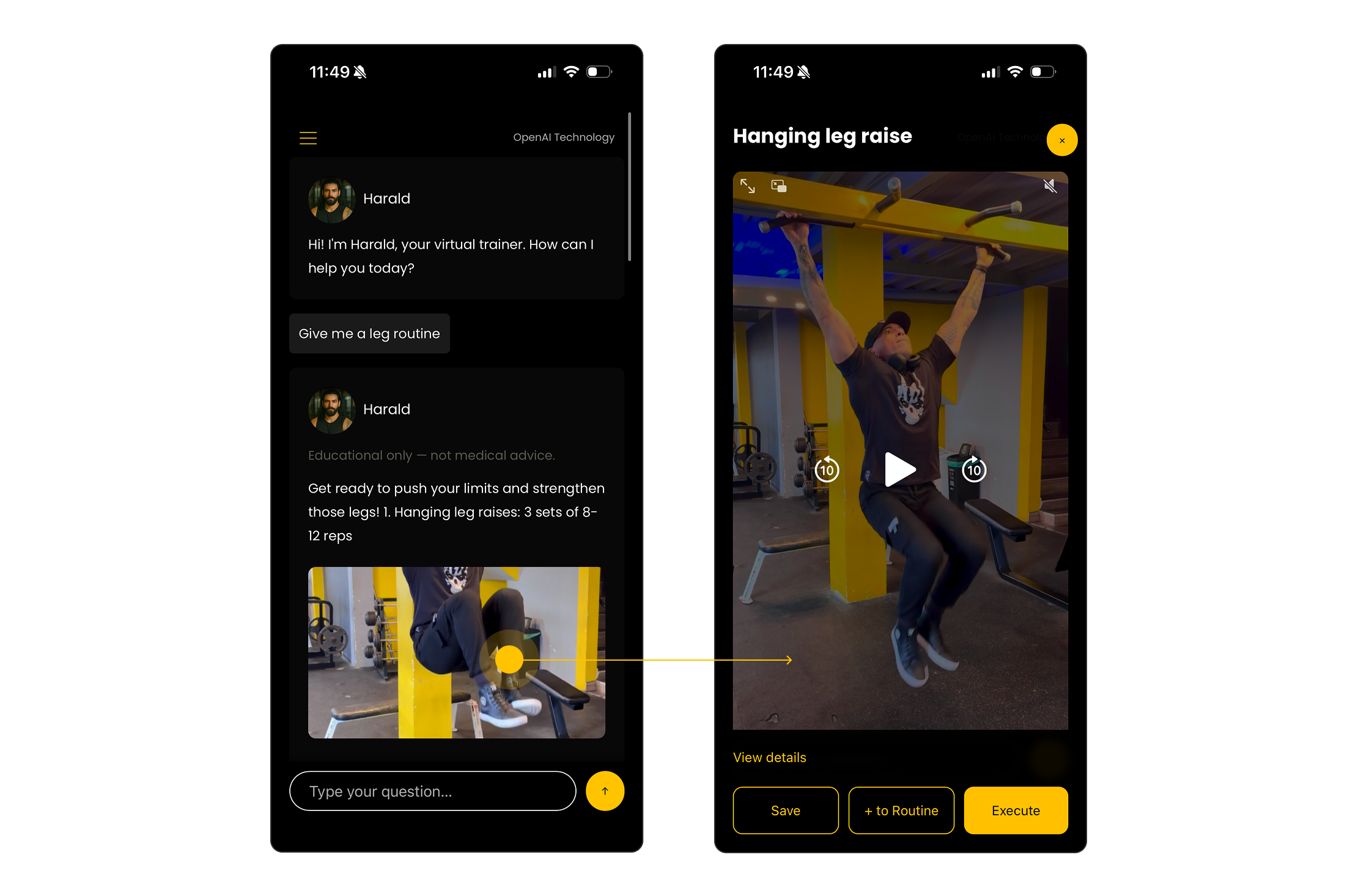
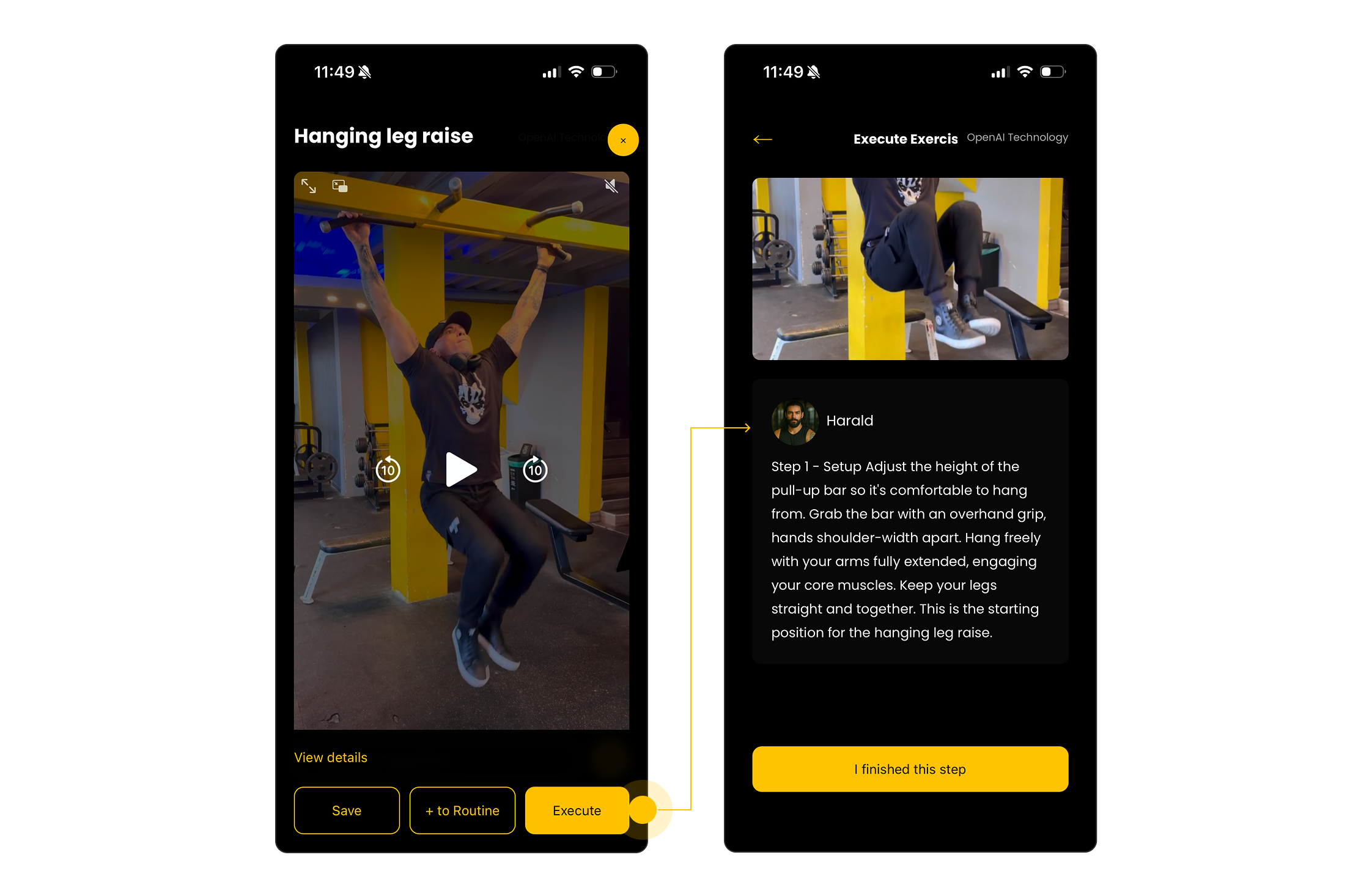
When the AI recommends an exercise, the user can open a detailed view with a short demo video, exercise details, safety tips and quick actions.
4 — Execute mode
Execute mode guides users through each step of the exercise, raising confidence and reducing guesswork.
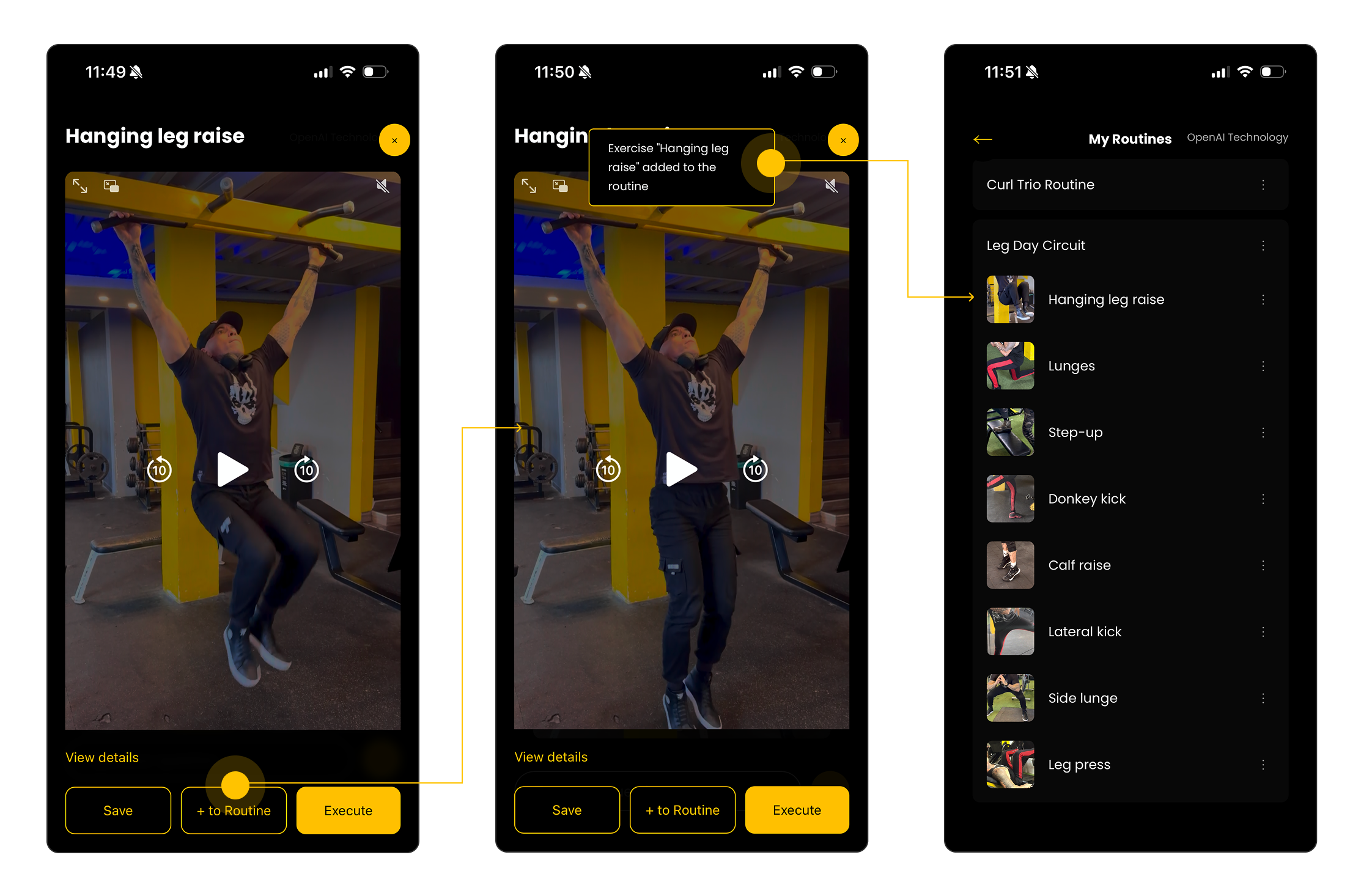
5 — Optional flows
Users can save exercises and build routines to create their own library and review later. These actions enhance customization without interrupting the main training flow.
6 — Paywall
To keep the experience smooth and non-intrusive, the paywall only appears at meaningful moments, specifically when the user reaches a limit or attempts to perform a restricted action in the free tier like Execute Exercise. Instead of stopping their flow, the app informs them of the limitation and offers the option to upgrade, turning natural points of engagement into conversion opportunities without breaking the user experience.
See a Demo
Here’s a demo of the actual app running on my iPhone.
04 - Testing & Early Validation
To validate the concept early, I tested the MVP with 8 users: 5 beginners from my gym, 1 intermediate user (my wife), and 2 UX designers. The goal was not performance benchmarking but understanding usability, clarity, and perceived value. Moving from voice to chat made a real difference. Users felt they had more control, could re-read complex explanations, and weren't blocked by gym noise. Having the conversation written out turned out to be one of the biggest advantages of the whole switch.
Key Early Metrics
100%
100% of testers expressed strong interest in using the app once fully released. They described the experience as “supportive”, “easy to understand”, and “much better than trying to figure things out alone.”
80%
80% reported that the chat format significantly increased their understanding of exercises. They highlighted how rereading instructions, videos, and safety cues reduced anxiety and guesswork.
These early insights validated the core concept and guided the next steps toward refining the user experience and preparing for broader testing on TestFlight.
06 - Key Takeaways
Building Gymyan wasn’t just a product challenge, it was a personal one. I wanted to understand how far I could push myself beyond design, stepping into unfamiliar territory like AI pipelines, backend logic, vector databases, and iOS deployment. What I learned goes far beyond interfaces.
What this project taught me:
→ I can build more than I thought. With enough curiosity (and a lot of stubbornness), I moved from idea → prototype → a working native app on TestFlight.
→ Design alone isn’t enough, ecosystems matter. Shipping an AI-driven product forces you to understand architecture, constraints, costs, and how different systems talk to each other.
→ AI lowers barriers, not complexity. It accelerates learning, but real products still require reasoning, structure, and intentional decision-making.
→ Validation beats assumptions. Every major pivot came from real people using the product, not from theory or planning.
→ Building is the best form of discovery. I didn’t just design an app. I learned what it means to create something that could become a real business, with real users, real expectations, and real technical weight behind it.